When Tokyo
Gets Dark
Every night-photography question about Tokyo eventually becomes the same question: what time does it actually get dark? Guidebooks do not answer it, and the answer moves by more than two hours across the year. So we calculated it — sunset, the end of blue hour, and the moment the sky is genuinely black — for every day of the year in central Tokyo.
The Short Answer
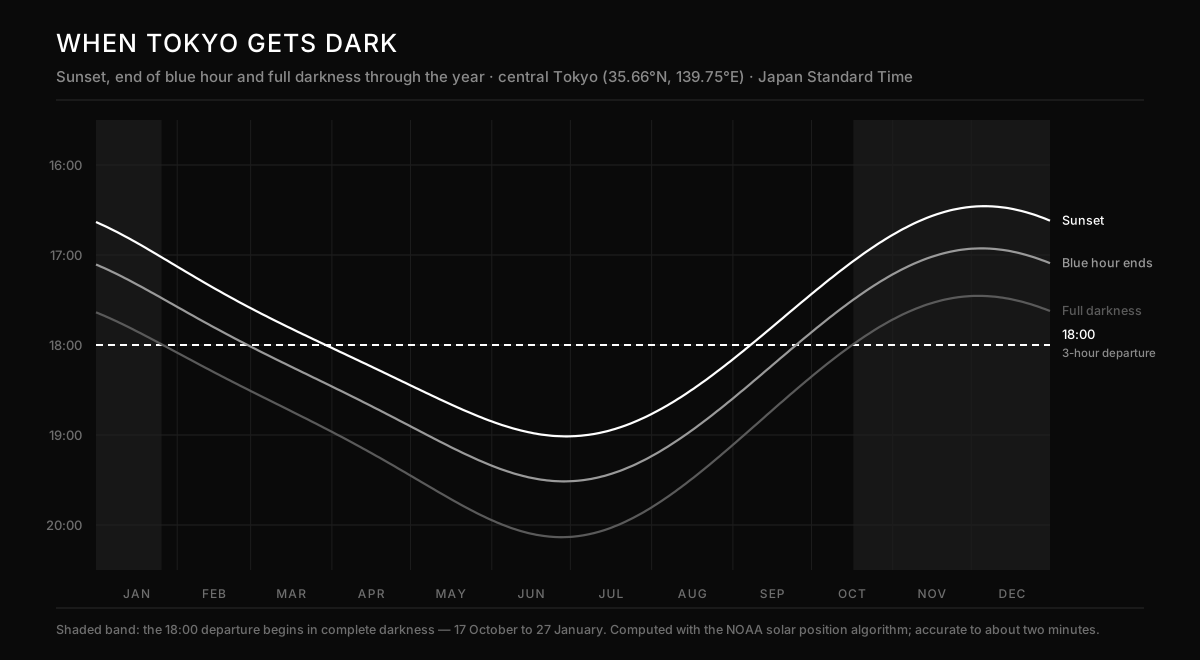
In central Tokyo the sun sets as early as 16:28 in early December and as late as 19:00 in late June. Blue hour — the usable window after sunset — lasts 25 to 30 minutes, and the sky is fully dark roughly an hour after sunset. For anyone planning an evening around photographs, the useful date is 17 October: from then until 27 January, Tokyo is already in complete darkness by 18:00.
The Three Dates That Matter
If you are choosing between trip dates, these are the thresholds. All are for 2026 and shift by a day or so year to year.
| Threshold at 18:00 | Dates | What you get at an 18:00 start |
|---|---|---|
| Sky completely dark | 17 October – 27 January | Black sky, city lights at full strength, from the first minute |
| Past blue hour | 26 September – 28 February | Dark, with the last of the twilight gone |
| Sun already down | 8 September – 30 March | Sunset has happened; blue hour is in progress |
| Still daylight | 31 March – 7 September | The first part of the evening runs in daylight |
This is why a December booking and a June booking are not the same product. In December the entire evening is night. In June you will watch the sun go down from the passenger seat, which some people prefer — but if the photographs are the point, you are losing the first hour.
Full Table — Central Tokyo
Times are Japan Standard Time. Blue hour ends is the end of civil twilight, when the sun is 6° below the horizon and artificial light starts to dominate. Full darkness is the end of nautical twilight, at 12° below.
| Date | Sunset | Blue hour ends | Full darkness | Blue hour length |
|---|---|---|---|---|
| January 1 | 16:38 | 17:06 | 17:38 | 28 min |
| January 15 | 16:50 | 17:18 | 17:49 | 28 min |
| February 1 | 17:08 | 17:35 | 18:05 | 27 min |
| February 15 | 17:22 | 17:48 | 18:18 | 26 min |
| March 1 | 17:35 | 18:01 | 18:31 | 26 min |
| March 15 | 17:48 | 18:13 | 18:43 | 25 min |
| April 1 | 18:02 | 18:28 | 18:58 | 26 min |
| April 15 | 18:14 | 18:40 | 19:11 | 26 min |
| May 1 | 18:27 | 18:54 | 19:27 | 27 min |
| May 15 | 18:38 | 19:07 | 19:41 | 28 min |
| June 1 | 18:51 | 19:20 | 19:57 | 29 min |
| June 15 | 18:58 | 19:28 | 20:05 | 30 min |
| July 1 | 19:01 | 19:31 | 20:08 | 30 min |
| July 15 | 18:57 | 19:27 | 20:03 | 29 min |
| August 1 | 18:46 | 19:14 | 19:48 | 28 min |
| August 15 | 18:31 | 18:59 | 19:31 | 27 min |
| September 1 | 18:10 | 18:36 | 19:07 | 26 min |
| September 15 | 17:49 | 18:15 | 18:45 | 26 min |
| October 1 | 17:26 | 17:51 | 18:21 | 25 min |
| October 15 | 17:07 | 17:32 | 18:02 | 26 min |
| November 1 | 16:47 | 17:13 | 17:43 | 26 min |
| November 15 | 16:35 | 17:02 | 17:33 | 27 min |
| December 1 | 16:28 | 16:56 | 17:27 | 28 min |
| December 15 | 16:29 | 16:57 | 17:29 | 28 min |
🧭 Tokyo’s blue hour is short. At 35.7°N the sun drops steeply, so the window between sunset and the end of civil twilight is only 25–30 minutes — against roughly 40 minutes in London and over an hour in Stockholm in midsummer. If you are shooting a car against a deep blue sky in Tokyo, you have about half an hour, not an evening. Plan the one shot you want and be in position early.
Best Departure Time for the 1-Hour Route
The 1-hour ride runs Tokyo Tower, Rainbow Bridge and Odaiba, Shibuya Scramble, then Ginza and the Imperial Palace. To reach the first landmark inside blue hour, leave your hotel about 45 minutes before sunset.
| Month | Suggested departure | Sunset | Blue hour ends |
|---|---|---|---|
| January | 16:05 | 16:50 | 17:18 |
| February | 16:37 | 17:22 | 17:48 |
| March | 17:03 | 17:48 | 18:13 |
| April | 17:29 | 18:14 | 18:40 |
| May | 17:53 | 18:38 | 19:07 |
| June | 18:13 | 18:58 | 19:28 |
| July | 18:12 | 18:57 | 19:27 |
| August | 17:46 | 18:31 | 18:59 |
| September | 17:04 | 17:49 | 18:15 |
| October | 16:22 | 17:07 | 17:32 |
| November | 15:50 | 16:35 | 17:02 |
| December | 15:44 | 16:29 | 16:57 |
Leaving at that time puts Tokyo Tower in blue hour, Rainbow Bridge just as the bay goes dark, and Shibuya and Ginza under full artificial light — which is when those two actually look their best. If your evening has to start later, nothing is ruined; you simply trade the blue sky for deeper blacks.
What Each Stop Wants
| Location | Best light | Why |
|---|---|---|
| Tokyo Tower | Blue hour, first 20 minutes | The orange lattice needs a blue sky behind it. After full darkness the tower still reads, but the sky becomes a flat black rectangle. |
| Rainbow Bridge & Odaiba | End of blue hour | The bay holds light longer than the city. You want the water still faintly blue with the bridge already lit. |
| Shibuya Scramble | Full darkness | Entirely artificial light. Twilight actually works against you by lifting the shadows the neon is supposed to fill. |
| Ginza & Imperial Palace | Full darkness | Shopfront lighting is the subject. The palace moat reflects best with no sky competing. |
| Daikoku PA | Full darkness, 19:30 onward | Overhead floodlighting. It photographs the same at 19:30 and 23:00 — what changes is how many cars are there, not the light. |
Season, Not Just Time
The clock is only half of it. Winter air over Tokyo Bay is dramatically clearer than summer air, and that shows up in every long-distance frame.
| Period | Air and sky | Verdict for photographs |
|---|---|---|
| November – February | Clearest air of the year, fully dark by 18:00 | The best window. Bring a coat — Daikoku is exposed and over water. |
| March & October | Mild, blue hour lands mid-evening | Very good, and the most comfortable to stand around in. |
| April & September | Variable; typhoon risk in September | Good, but keep a spare evening in the itinerary. |
| May – August | Humid, hazy over the bay, late sunset | Workable, but the bay loses definition and the evening starts in daylight. |
Rain is not the enemy people assume. Wet asphalt doubles every light source in the frame, and a wet Ginza at night is easier to photograph well than a dry one. What genuinely hurts is summer haze, which softens the skyline across the water and cannot be fixed afterwards.
How These Numbers Were Produced
Calculated with the NOAA solar position algorithm for 35.66°N, 139.75°E — central Tokyo, near Tokyo Tower — in Japan Standard Time, which has no daylight saving. Sunset uses the standard −0.833° solar elevation, which accounts for atmospheric refraction and the radius of the solar disc. Blue hour ends at civil twilight (−6°) and full darkness at nautical twilight (−12°).
We checked the output against published sunset times for Tokyo and it agrees to within about two minutes, which is well inside the margin that matters for planning. Figures are for 2026; they move by roughly a day either side in other years. Tall buildings will take the sun several minutes earlier than the horizon does, so treat these as the outer limit of the light rather than a guarantee.
Frequently Asked Questions
Book the Light, Not Just the Date
¥100,000 for one hour, ¥180,000 for three hours to Daikoku PA. Tell us the shot you want and we will pick the departure time around it.
View Packages & BookAsk on WhatsApp