How to Get
to Daikoku PA
This is the question that stops most people, and almost every answer online skips the hard part. Daikoku Parking Area sits inside an expressway interchange. There is no station, no bus stop and no legal way to walk in. If you are planning a visit, the honest options are fewer than you think — and three of the four have conditions attached.
The Short Answer
You can only reach Daikoku PA in a vehicle that is already on the Shuto Expressway. There is no train, no bus, no pedestrian entrance, and taxi drivers frequently refuse the route because it means a toll run to Yokohama with no return fare.
Entry to the parking area itself is free — the entire cost of visiting is the cost of getting there. In practice visitors use one of four routes: a passenger tour, a self-drive rental, a friend with a car, or a taxi that agrees in advance.
Where It Actually Is
| Japanese name | 大黒パーキングエリア (Daikoku Parking Area), often written Daikoku PA or 大黒PA |
| Location | Daikoku Futo (大黒ふ頭), Tsurumi-ku, Yokohama, Kanagawa Prefecture |
| Road | Shuto Expressway Bayshore Route (首都高速湾岸線), within the Daikoku interchange |
| Approximate coordinates | 35.4547°N, 139.6928°E |
| Open | 24 hours. It is a public rest area, not an event venue. |
| Entry fee | None. The expressway tolls to get there are the cost. |
| Distance from central Tokyo | Roughly 30–40 km depending on where you start |
| Pedestrian access | None. The site is enclosed by expressway ramps over water. |
The geography is the whole problem. Daikoku Futo is a man-made island in Yokohama harbour, and the parking area sits in the middle of a spiral interchange that links the Bayshore Route to the Yokohama Bay Bridge. Everything around it is elevated carriageway. You cannot approach it on foot from the island, because the parking area is on the expressway side of the fence.
The Four Ways In
1. A passenger tour — no licence needed
Someone else drives, you ride. This is the only option that requires nothing from you: no Japanese licence, no International Driving Permit, no deposit, no confidence driving on the left at night. Operators run from roughly ¥15,000 per person for a shared JDM tour up to ¥180,000 for a private supercar.
The practical advantage is not the car, it is the driver. Daikoku is unpredictable — some nights it is packed, some nights it is nearly empty, and the police sometimes close the entrance ramp without warning. Someone who goes regularly knows which nights are worth it and where the scene moves when the lot is shut.
2. Rent a car and drive yourself
Entirely possible if your paperwork is right, and genuinely satisfying if you came to Japan to drive. The requirements catch people out:
- Japan only accepts International Driving Permits issued under the 1949 Geneva Convention. A 1968 Vienna Convention permit is not valid here.
- Drivers from Germany, Switzerland, France, Belgium, Monaco, Estonia, Slovenia and Taiwan need an official Japanese translation of their home licence from JAF or their embassy, arranged in advance.
- Holders of mainland Chinese licences cannot drive in Japan at all — China is not a signatory and translations are not accepted.
- Expect an age minimum (often 26 for performance cars), a security deposit, and an insurance excess.
Add the practical load: left-hand traffic, an expressway interchange that branches three ways in fifty metres, electronic tolls, and parking in Tokyo that costs more than the fuel. Plenty of people do it anyway and enjoy it.
3. A friend or local with a car
The cheapest route by far, and how most of the people you will meet there arrived. If you know anyone in Tokyo with a car and an interest in the scene, ask — Daikoku is a normal night out for them. Offer to cover the tolls and the fuel; it is the done thing.
4. A taxi — possible, usually refused
Worth being straight about. A taxi can physically take you, but drivers often decline. The run is 30–40 km each way on toll roads, ending at a place where they are unlikely to pick up a return fare, and many drivers do not recognise the destination as somewhere a tourist would want to go.
If you try it: book a hire car with a driver in advance rather than hailing one, confirm the destination as 大黒パーキングエリア on the 首都高湾岸線, agree the waiting time before you set off, and expect a fare well above a normal city trip once tolls are included. Do not get dropped off and plan to find a ride back — there will not be one.
| Option | Licence needed | Rough cost | Main risk |
|---|---|---|---|
| Passenger tour | None | ¥15,000–¥180,000 pp | None, beyond a closure |
| Self-drive rental | Licence + 1949 IDP | Rental + deposit + excess + tolls | Paperwork refused at the counter |
| Friend with a car | Theirs | Tolls and fuel | Needing to know someone |
| Taxi / hire car | None | High, plus tolls both ways | Refusal, and no ride home |
Drive Times from Central Tokyo
Indicative, in normal evening traffic, using the Bayshore Route. Tokyo traffic makes a liar of every estimate, so treat these as the best case.
| Starting from | Approximate drive |
|---|---|
| Shibuya | 40–50 minutes |
| Shinjuku | 45–55 minutes |
| Ginza / Marunouchi | 35–45 minutes |
| Odaiba / Toyosu | 25–35 minutes |
| Haneda Airport | 20–30 minutes |
| Yokohama Minato Mirai | 15–20 minutes |
The drive is a genuine part of the experience rather than dead time. The Bayshore Route runs elevated along Tokyo Bay, past the container cranes and across the Yokohama Bay Bridge, and at night it is one of the better views of the city that almost no visitor sees.
What Happens When You Arrive
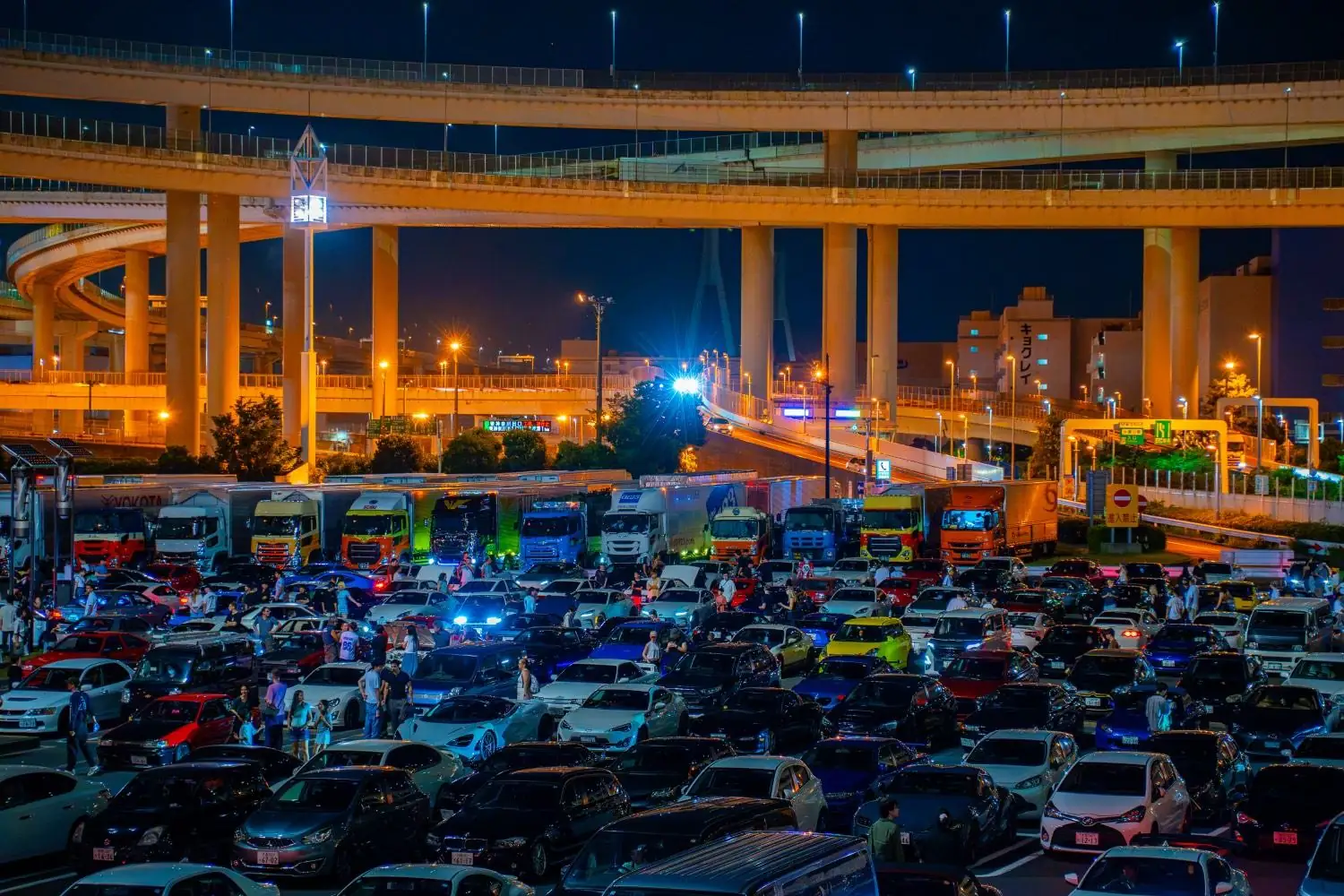
You pull into an ordinary motorway services. There is no gate, no ticket, no list. Cars park, people get out, and the gathering simply exists in the car park. Walk around freely.
A few things that are not obvious:
- It is a working rest area. Trucks use it all night, and the truck section is separate from where the gathering happens. Stay out of the lorry bays.
- Ask before photographing someone's car up close. Nearly everyone says yes and many will open the bonnet for you. Climbing on cars, touching paint or leaning in through windows is how you get the cold shoulder.
- No revving, no burnouts, no noise. This is the behaviour that gets the entrance closed for everybody, and the regulars will not thank you for it.
- There is no schedule. Nobody organises this. Who turns up is different every night.
When to Go
Cars gather after dark and the lot is at its fullest roughly between 21:00 and 01:00. Friday and Saturday draw the biggest turnout and carry the highest risk of a police closure — that trade-off is real and unavoidable. Tuesday to Thursday is the dependable choice.
Season matters more than people expect, because what you are photographing is lit by floodlight against a night sky. Tokyo's sunset moves by two and a half hours across the year: the sky is completely dark by 18:00 only between 17 October and 27 January. We calculated the full set of sunset and twilight times for central Tokyo, which you can use to plan the evening: When Tokyo Gets Dark.
If the Entrance Is Closed
Kanagawa police close the Daikoku entrance ramp when the crowd grows too large, most often on Friday and Saturday nights and around major holidays. No operator, guide or website can promise you access, and anyone who does is promising something outside their control.
The two standard alternatives are both reached the same way — by expressway:
| Alternative | Where | What it is like |
|---|---|---|
| Umihotaru PA | Tokyo Bay Aqua-Line, mid-bay | An artificial island with open decks and water on all sides. Photographically arguably better; culturally quieter. |
| Tatsumi PA | Shuto Expressway, Koto-ku, Tokyo | Smaller and closer to the city, with a long-standing night-driving association. |
Ask whoever is driving what their alternative is before you set out. A good answer exists; no answer is a warning.
Five Mistakes People Make
| Mistake | What actually happens |
|---|---|
| Planning to take a train and walk | There is no route. The nearest stations are on the mainland, separated by harbour and expressway. |
| Assuming a taxi will wait | Many will not, and no replacement will come. Agree waiting time in writing before leaving. |
| Arriving at 19:00 expecting a full lot | Too early most nights. The gathering builds after 21:00. |
| Booking the last night of the trip | If the ramp is closed or a typhoon lands, there is no second chance. Keep a spare evening. |
| Treating it as an attraction | It is other people's private property in a public car park. Behave as a guest and you will be treated as one. |
Frequently Asked Questions
We Are One of the Four Ways In
¥180,000 per person for the 3-hour evening ride to Daikoku PA, all-inclusive, with free hotel pickup and no licence required. Ask about your date before you book anything.
View Packages & BookAsk on WhatsApp